
🧠🤝🧠 Brains Across Borders
Understanding how different teams work together helps solve complex problems

A few weeks ago I realized that teams within my company may not know how to work together. We were all nice to each other, but did we actually know how to hand work off to one another and get specific deliverables from each other to win together? I would say no.
Instead of just complaining about this, I decided to participate in the change to improve our cross-functional collaboration.
💡 Your Quick Takeaways
Mastering cross-functional thinking makes you a key player in your organization.
You’ll help others excel in their roles, making you critical to successful projects.
Cross-functional work is like a relay race.
Each person (role/function) runs their leg of the race, but the baton (idea/project) has to be passed to each member of the team to reach the finish line (end goal).
Ask others how they want to work with you.
Understanding what each team needs from you builds trust and ensures smooth collaboration.
Empathy is the key to better cross-functional projects.
Actions to try:
Ask someone in another role to explain their processes in plain terms.
Join a project with another team to see their perspective.
Practice summarizing your work so that anyone—technical or not—can understand.
🌎 The Big Picture
Much of my experience is working with startups where the teams are quite small. It is easy for 2-3 people to share the workload and stay aligned at a small company. As companies or teams grow, teams often hit a common hurdle: they don’t fully understand what each person does.
Invisible walls form, and while everyone’s working toward the same goal, they’re not fully supporting each other. This causes negative feelings to linger and grow.
This is what we want to avoid.
The key to solving this is Empathy.
When a software engineer says, “If we do it that way, it’ll make it harder for Customer Success to support,” it shows something powerful—a culture where people think about how their decisions impact others. That’s how teams move from just coexisting to truly collaborating.
I’ve been in situations where we are just coexisting and it is SO MUCH WORSE compared to truly collaborating.
🔍 Go Deeper
It takes effort to be the person that crosses the invisible wall between departments. This is because “just coexisting” is so easy. Projects are still getting completed, deadlines are being met, and your customers seem happy.
However, there is a feeling that things aren’t getting done as easily as they could be getting done. Or there is often a feeling of dread when you have to cross the invisible wall to ask for help.
Imagine how easy and more enjoyable work could be if those feelings weren’t there. Being the person who puts in this effort first is very rewarding.
It’s scary to put yourself out there because someone from the other side may not reciprocate. Something I’ve learned is that they often feel the same way as you do. It’s scary for them to reach out to you, but someone has to do it first. Being the first person to reach out to grow empathy for the other function has magical effects on your relationship with them. They will immediately feel like you care about their work (which you should care about) and that you’re someone they can go to from the other team with their questions because you have an understanding that others do not.
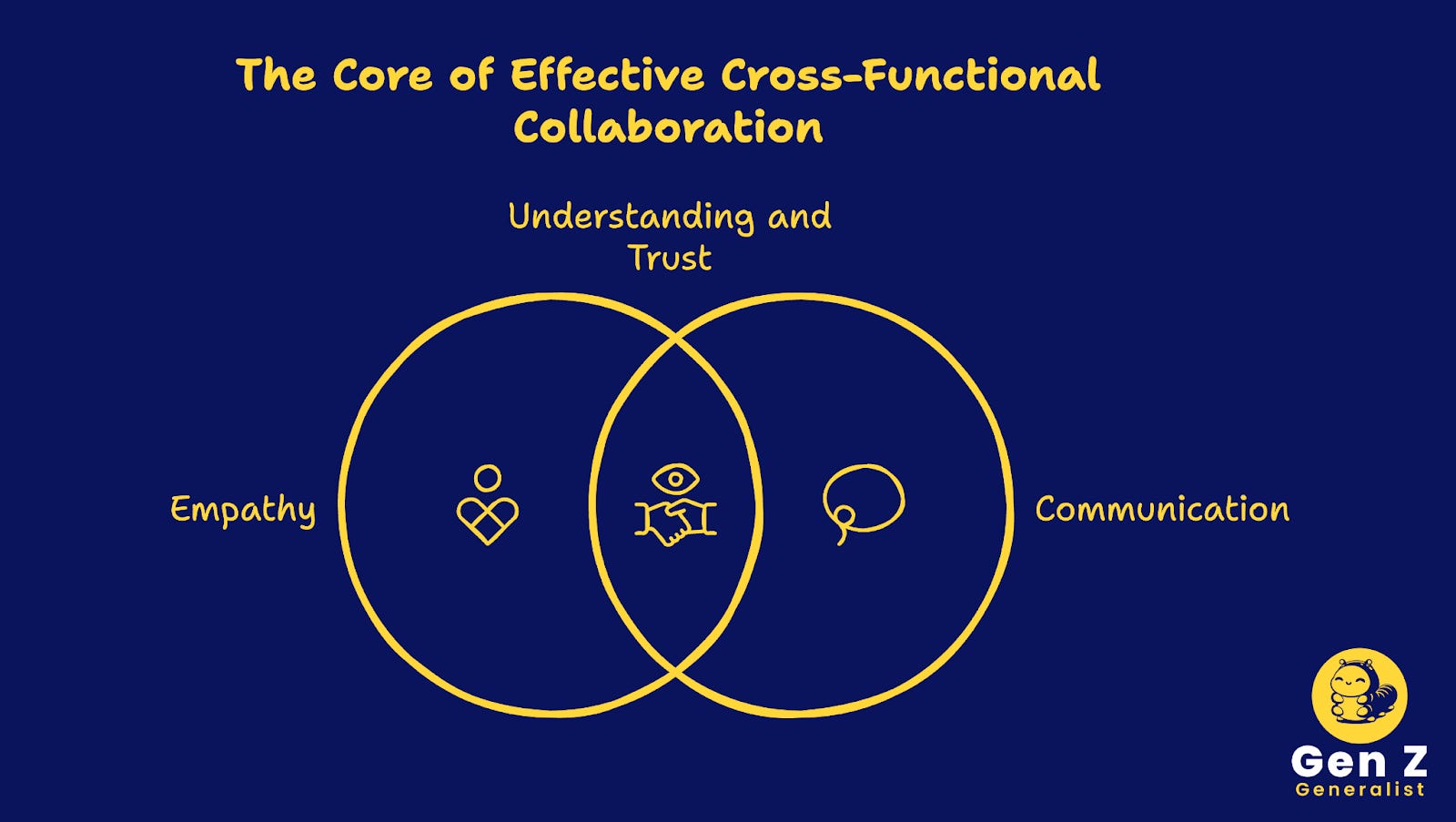
🤝💡 Building Empathy Between Teams
Thankfully, building empathy between teams is quite easy and takes very little time out of your day. Here are some easy things you can do that allow you to get a better understanding of the other teams within the company and behaviors you can encourage in others for them to also build that empathy:
Ask someone in another role to explain their processes in plain terms.
If your work happens a certain way, we often make the mistake of thinking “That must be how everyone works! It just makes sense to do it this way!”
But this is not always true. Different people think differently. Different teams have their own culture and unspoken rules. It’s important not to assume that they are like you.
Crossing the invisible wall and asking, “Hey Chris, could you show me how you do ____ please? I want to make sure the work I’m doing is easy for you to work with.”
Once they show you one process, you can say, “I appreciate you showing me that, but that makes me curious, how do you do _____?”
At the end of the conversation you can say, “Wow I didn’t know everything that went into your role, you’re responsible for a lot! Would it be helpful for me to give you a little tour of my processes so that we have a good understanding of each other’s responsibilities?”
They will always say “Yes! I’d love to!”
Join a project with another team to see their perspective.
If there are projects from another team that need representation from your team, volunteer to do that work rather than waiting to be assigned. Others will take notice when you say, “I’d love to work with marketing on this, they’re fun to work with!”
Practice summarizing your work so that anyone—technical or not—can understand.
It’s important to speak in terms others understand so that your role doesn’t look like a foreign language to them.
Here is an article to help you break down complex ideas into simple terms for anyone.
🏃♂️🔗🏃♀️ Cross-functional Relay Races
Building empathy between teams is the easy part—it’s the foundation for breaking down invisible walls. The harder part is becoming intentional about how teams collaborate.
The big question: Who is responsible for what, and when do they do it?
As teams grow, tasks shift. Something you used to handle 100% might now only be 50% yours, with others taking over the rest. It’s challenging, but that’s where teamwork shines.
Here’s the key: focus on the outcome.
If everyone knows the end goal and understands each other’s strengths (thanks to that empathy you’ve been building), you can create a system while engaging everyone involved where work flows seamlessly. Think of it like a relay race:
Each person runs their leg of the race.
The baton (idea/project) must be passed to the next person to reach the finish line (end goal).
And remember: the baton pass is just as important as running the race! A failed pass means the whole team stumbles.
If your teammates don’t see this yet, share examples of failed baton passes (even your own). Being vulnerable about past mistakes fosters understanding and shows you care about getting it right this time.
❤️ Personal Example
We just released a new mobile app at our company and it was a smashing success! EVERYONE at the company was involved in the success of the project.
Engineering was responsible for the technology
Customer Success was responsible for the training materials and ongoing support
Marketing was responsible for the materials we used to announce the launch
Every team member contributed to Quality Control by testing the apps
This project took much shorter than it would have to complete if we weren’t all working together towards the same mission. I’d like to think this project brought us closer together.
💯 The Results
This is a lifelong skill in all aspects of life. Whether you are working with multiple teams or playing in a basketball league after work, cross-functional work is always there.
Doing this work will help everyone feel less stressed, improve camaraderie, and improve your team’s performance along with your own.
📈 Career Boost
People notice who breaks down the invisible walls between departments first
These are the go-to people who receive the best opportunities first
Building empathy between team helps tremendously when trying to work together
It will lower many of the negative feelings teams have at work
💌 Spread the Word
If you found this valuable, share Gen Z Generalist with friends, teammates, or anyone ready to make an impact. Let’s grow the community of future leaders—one share at a time!