
🧠✨ Complex Ideas ➡️ Simple Stories
Ever felt overwhelmed by someone explaining something way too complicated? Let’s make sure you’re never that person.

Words: 964 | Est. Reading Time: 4 mins
💡 Your Quick Takeaways
When sharing your work with non-technical stakeholders, they are less worried about how something is done and care more about why it matters.
A marker needs to know how the new product will affect their messaging
A CFO wants to know how streamlining a process will impact Q4 numbers
Use simple analogies to explain concepts in terms the person is familiar with
Analogy: Teamwork is like playing in a band
Explanation: Everyone has a different instrument (role), but you must play together to make a good song (achieve the goal)
Don’t use complex and confusing language
People appreciate it when you talk to them in terms meant for a 5th-grader
Hemingway App is a great way to check the reading level of written text
If you are explaining something lengthy, break it down into parts
Ordering from DoorDash is easy—just 3 steps:
Download the app and sign up. (Get started)
Pick your food and place your order. (Choose and pay)
Wait for delivery to your door. (Sit back and relax)
🌎 The Big Picture
Today, I’m focusing on a part of communication that I struggled with, sharing technical concepts with non-technical stakeholders.
I work in Software Product Development where the engineering team needs different information from sales, marketing, customer success, and senior leadership. Just as important, the customer of our services doesn’t need to know all the complexities of what’s under the hood, they need to understand why a product/feature is valuable for them.
When you’re putting lots of thought into your work, it’s easy to get into the weeds when explaining it to others because you’re living through all the small details. However, a lesson for me was when I realized that people will ask for more information if they need more information and often appreciate only receiving the details they care about.
Once you get into the groove of only sharing the details that are important to stakeholders, they’ll start coming to you immediately for information because they know:
You have valuable information
You deliver information in a way they understand
They can make better decisions when equipped with your information
This makes you very valuable to the organization especially if you are a “knowledge worker”, a person who is tasked with thinking through complex problems. It doesn’t matter how much you think about complex topics, you need to be able to convey those ideas to others. The communication of the ideas is 80% of your value in this type of role.
🔍 Key Strategies
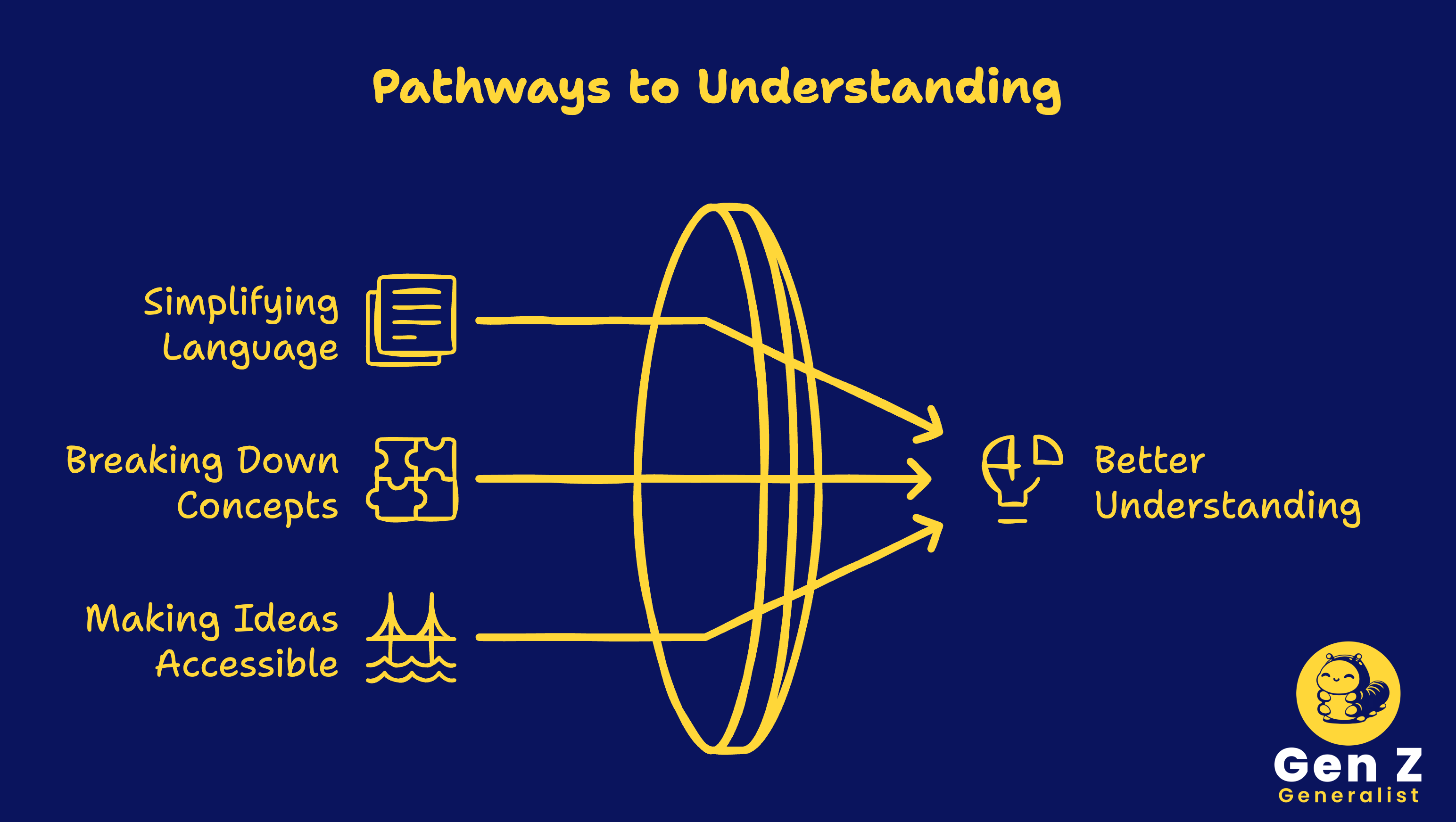
🎯 Focus On Why It Matters
People often only care about “What’s in it for me?”. Here’s what someone is thinking when you share information:
Does this make more work for me?
Do I have to do anything differently?
Will this improve the outcomes I am accountable for?
Do I have to make adjustments to a plan I already had?
So when communicating:
Instead of: "We need to increase our email open rates by A/B testing subject lines and send times."
Say: "Testing different subject lines and send times will help us grab more attention and get more people to read our emails."
The second example here shares how something is done and combines why it matters in a simple statement. If a marketing manager listens to that from a junior marketer, I can now ask pointed questions about the plan and expected results.
Read more about Starting With Why here.
🌉 Using Simple Analogies
People already have knowledge in their brains about lots of topics they’ve experienced in life. They are experts on many things they know.
So when learning something new, it’s easy for us to relate a new concept to something old they already know about. It’s important to tailor these analogies to the audience. If your boss is a big music person, an analogy like this makes immediate sense to them:
Analogy: Teamwork is like playing in a band
Explanation: Everyone has a different instrument (role), but you must play together to make a good song (achieve the goal)
✂️ Avoid Complex Language
Have you ever spoken to someone who uses big words to sound smarter? Then you miss what 30% of the words mean, and leave the conversation more confused than you originally were.
Avoid this!
Acronyms and big words are hard to understand and are difficult to skim when communicating in writing.
Difficult Sentence: "Ensuring a proper circadian rhythm is crucial for optimizing cognitive performance and maintaining overall well-being."
Easy Sentence: "Getting enough sleep helps you think clearly and feel good."
Again, tailor your message to the person you are communicating with. If you are talking to a 5-year-old, simple is good. But if you are talking to a world-renowned expert in the field, using complex terms is expected.
🧩 Break Down Lengthy Topics
Sometimes the things you are explaining happen to be complex and there is no getting around that. However, when this is the case don’t spew a bunch of information in a giant message to someone. Break the topic down into points that are easy to follow.
Here is an example that is oversimplified but you are often able to do something similar:
Ordering from DoorDash is easy—just 3 steps:
Download the app and sign up. (Get started)
Pick your food and place your order. (Choose and pay)
Wait for delivery to your door. (Sit back and relax)
📈 Career Boost
People notice who communicates well and who doesn’t
Work on being someone who communicates complex topics in simple terms to non-technical stakeholders
Tailor your messages to the audience that you are communicating with
💌 Spread the Word
If you found this valuable, share Gen Z Generalist with friends, teammates, or anyone ready to make an impact. Let’s grow the community of future leaders—one share at a time!
I completely agree with you. Especially when you're talking to renowned experts in the field, using complex terms can sometimes make sense. However, I still believe it's usually better to keep things simple and maintain a clear flow. When presenting or discussing a new feature with stakeholders, it's important to focus on how it will affect them, whether they'll need to change their routines or adjust their workflows. Keeping it simple not only helps them understand the impact but also allows us to address potential questions they might not even have thought of yet. At the end it is communication that comes into play how well can you go about it I think